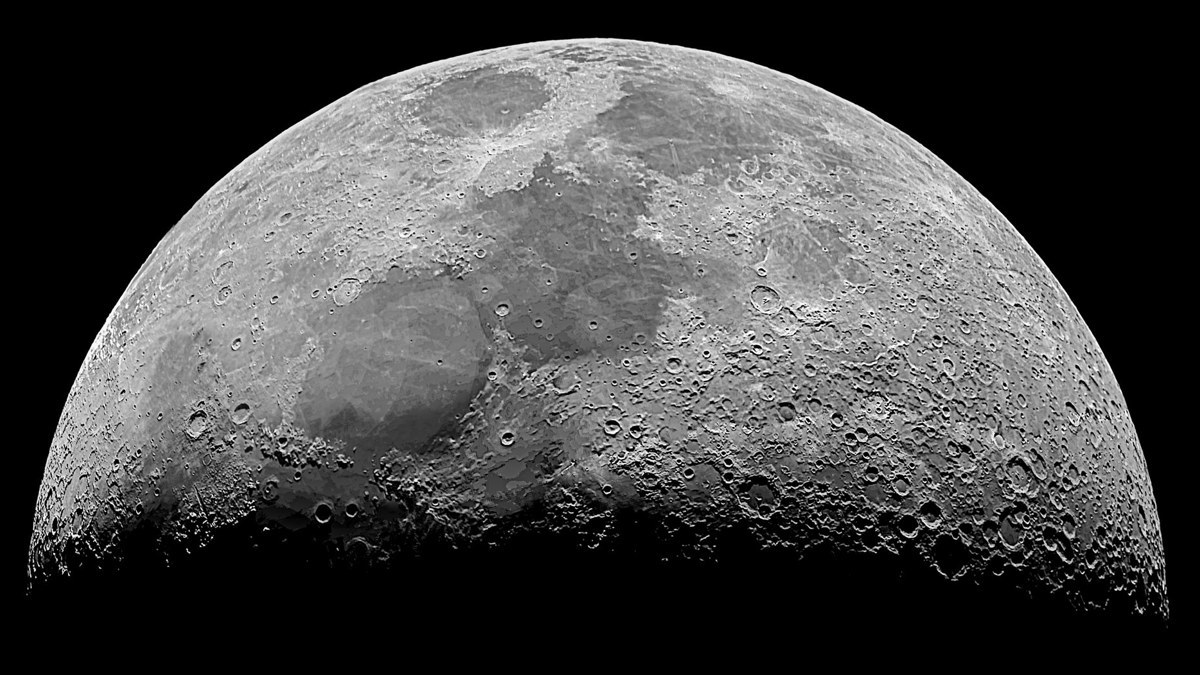
NASA and IBM release open lunar AI model for Moon mapping research
NASA and IBM released an open lunar AI model trained on LRO data to help map craters, ice prospects, and volcanic features.


NASA and IBM have released an open-source lunar foundation model for researchers who need to turn years of Moon observations into usable maps. NASA says the model is public on Hugging Face, with code available on GitHub, and IBM describes it as one of the first publicly available foundation models built specifically for scientific exploration of the Moon.
The practical target is not a chatbot for space trivia. It is a mapping tool for planetary scientists. NASA says the system was trained mainly on Lunar Reconnaissance Orbiter data, including roughly 2 million image tiles. That training set includes more than 1 million high-resolution camera images at 1-meter resolution and nearly 964,000 multispectral images at 100-meter resolution, with additional terrain and imagery data from missions including GRAIL, Lunar Prospector, and JAXA's SELENE/Kaguya.
Why the model matters
The Moon is a hard data problem before it is a landing problem. Researchers have to compare imagery, terrain maps, spectral readings, and other instrument data that were not originally designed as one neat machine-learning dataset. IBM says the project also produced a unified open lunar dataset with more than 30 spatially aligned layers from nine instruments across four missions.
IBM reports that the model improved several Moon-mapping tasks against a SwinV2-B baseline. In the cited technical results, it reduced error by up to 22% for areas with high potential for lunar ice, better captured irregular mare patches by 3%, and outperformed the baseline by nearly 19% for context-scale crater detection while using half the training data. Those are company and agency claims, but they are specific enough to matter because these tasks feed directly into where scientists look next.
What to watch
The immediate value is access. A shared pretrained model can let smaller research teams start with a capable lunar representation instead of building a specialized model from scratch for every crater, ice, or volcanism question. That could make lunar science less dependent on bespoke pipelines maintained by a few expert groups.
The CyberOGZ read is that this is a useful test case for scientific AI because the output has to survive contact with physics, mission planning, and limited labels. The model will be most valuable if outside researchers can reproduce the benchmark gains, adapt it to new regions, and find failure cases before anyone treats its maps as operational truth. Open release gives the community a fair shot at that scrutiny.
Sources
Cover photo by Micotino on Pexels, used under the Pexels License.



Comments (0)
Leave a Comment